
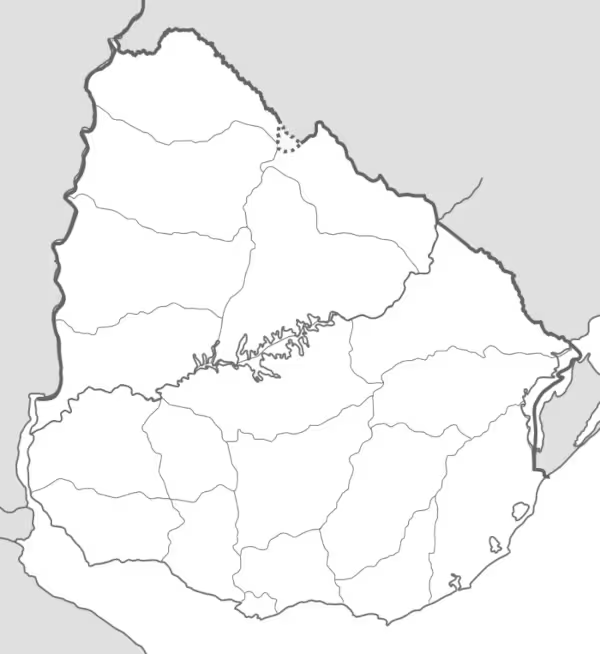
Here you’ll find a map with the political divisions of Uruguay, available for free download and printing.
This PDF-format map is an educational tool designed for students, teachers, and anyone interested in learning more about the country’s geography.
The map shows international borders as well as the boundaries of Uruguay. The map does not label regions or large cities.
Uruguay is a country located in southeastern South America, on the Atlantic coast. It borders Brazil to the north and northeast, Argentina to the west, and the Atlantic Ocean to the southeast, with the Río de la Plata forming its southern boundary. Its geographic position places it between two of the largest countries in the region, giving it strategic access to both river and ocean routes.
The country covers an area of approximately 176,200 square kilometers, making it one of the smaller nations in South America. Uruguay’s most important rivers include the Uruguay River, which forms much of the western border with Argentina, the Río Negro, which crosses the country from east to west, and the Río de la Plata, a major estuary vital for commerce and navigation. Numerous smaller rivers and streams also play a key role in agriculture and water supply.
Uruguay’s geography is characterized by gently rolling plains and low hills, known locally as cuchillas, with no major mountain ranges. The landscape is well suited for livestock farming and agriculture, which have traditionally been central to the country’s economy. Its coastline features sandy beaches, coastal lagoons, and estuaries, while the interior is dominated by fertile grasslands and river basins.
Administratively, Uruguay is divided into 19 departments, each governed by a local authority. The country has a population of approximately 3.5 million inhabitants, with a high degree of urbanization. A large share of the population lives in and around Montevideo, the capital and largest city, which functions as the political, economic, and cultural center of the nation.

Map of Uruguay
Find more content on Mentes Liberadas
That’s all for this article. I hope you enjoyed it.
You can make a donation to Mentes Liberadas through our Ko-Fi account. This way, you’ll be supporting the site, helping us create more content, resources, and online tools.
Thank you for taking the time to read.
See you in the next article on Mentes Liberadas.