
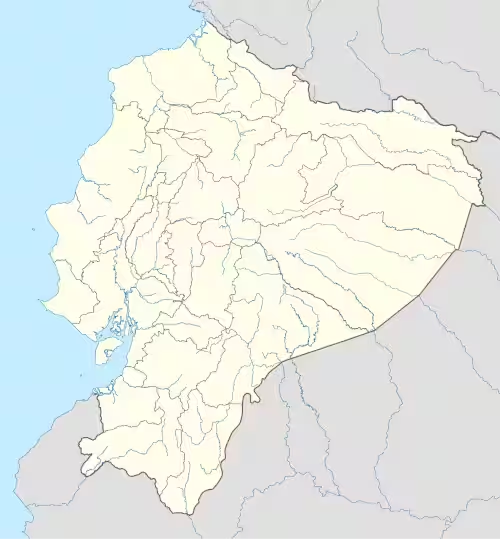
Here you’ll find a map with the political divisions of Ecuador, available for free download and printing.
This PDF-format map is an educational tool designed for students, teachers, and anyone interested in learning more about the country’s geography.
The map shows international borders as well as the boundaries of Ecuador. The map does not label regions or large cities.
Ecuador is a country located in northwestern South America, straddling the equator, from which it takes its name. It borders Colombia to the north, Peru to the east and south, and the Pacific Ocean to the west. In addition to its mainland territory, Ecuador also includes the Galápagos Islands, located in the Pacific Ocean about 1,000 kilometers west of the continental coast.
The country has a total surface area of approximately 256,370 square kilometers. Ecuador’s river system is extensive and diverse, with major rivers such as the Guayas River, the most important for commerce and drainage on the coast, and the Napo, Pastaza, and Putumayo Rivers, which are part of the Amazon basin. These rivers play a crucial role in transportation, agriculture, and hydroelectric power.
Ecuador’s geography is highly varied despite its relatively small size. It is traditionally divided into four natural regions: the Coastal Lowlands (Costa), the Andean Highlands (Sierra), the Amazon Rainforest (Oriente), and the Insular Region, formed by the Galápagos Islands. The Andes Mountains run north to south through the center of the country, creating dramatic volcanic landscapes, fertile valleys, and significant climatic contrasts.
Administratively, Ecuador is divided into 24 provinces, which are further subdivided into cantons and parishes. The country has a population of approximately 18 million inhabitants. A large portion of the population lives in urban areas, particularly in cities such as Quito, the capital located in the Andean highlands, and Guayaquil, the largest city and main commercial port on the coast.

Map of Ecuador
Find more content on Mentes Liberadas
That’s all for this article. I hope you enjoyed it.
You can make a donation to Mentes Liberadas through our Ko-Fi account. This way, you’ll be supporting the site, helping us create more content, resources, and online tools.
Thank you for taking the time to read.
See you in the next article on Mentes Liberadas.