
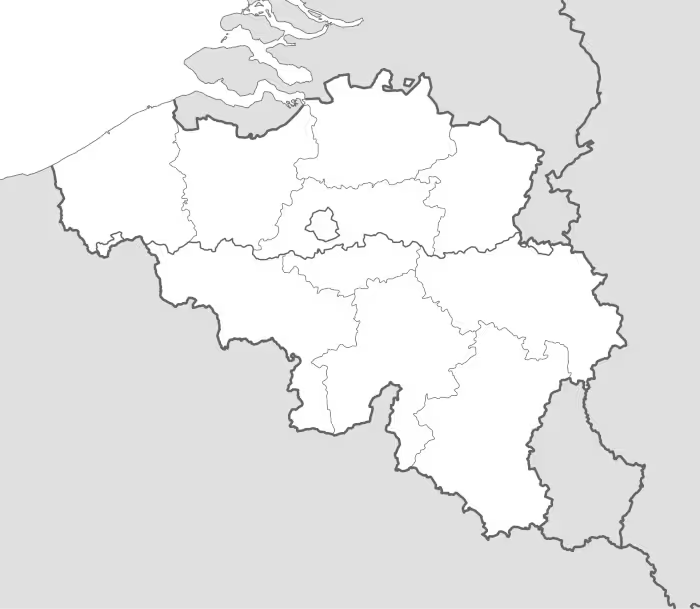
Here you’ll find a map with the political divisions of the Belgium, available for free download and printing.
This PDF-format map is an educational tool designed for students, teachers, and anyone interested in learning more about the country’s geography.
The map shows international borders as well as the boundaries of Belgium. The map does not label regions or large cities, and doesn’t include rivers.
Belgium is located in Western Europe and occupies a strategic position between the North Sea and the political heart of the European Union. It borders the Netherlands to the north, Germany and Luxembourg to the east, and France to the south and southwest, with a coastline along the North Sea to the northwest.
Covering roughly 30,500 square kilometers, Belgium is a relatively small country, yet it stands out for its high population density and its significant economic and diplomatic influence in the region.
The country is crossed by several important rivers that have played a key role in its historical and industrial development. The most notable are the Scheldt, which flows into the North Sea and connects major ports such as Antwerp, and the Meuse, which runs through Wallonia and serves as a vital waterway for transport and energy.
Belgium’s geography features coastal plains and lowlands in the north (Flanders), a central plateau of gentle hills known as the Brabant Plateau, and the Ardennes in the southeast, a forested and hilly region that contrasts with the rest of the country.
Administratively, Belgium is divided into three regions: the Flemish Region, the Walloon Region, and the Brussels-Capital Region. These regions are further subdivided into ten provinces and numerous municipalities.
The country is also organized into linguistic communities—Flemish, French, and German-speaking—reflecting its complex cultural identity. Belgium’s population is approximately 11.7 million people, making it one of the most densely populated nations in Europe and reinforcing its central role in European political affairs.

Map of Belgium
Find more content on Mentes Liberadas
That’s all for this article. I hope you enjoyed it.
You can make a donation to Mentes Liberadas through our Ko-Fi account. This way, you’ll be supporting the site, helping us create more content, resources, and online tools.
Thank you for taking the time to read.
See you in the next article on Mentes Liberadas.