
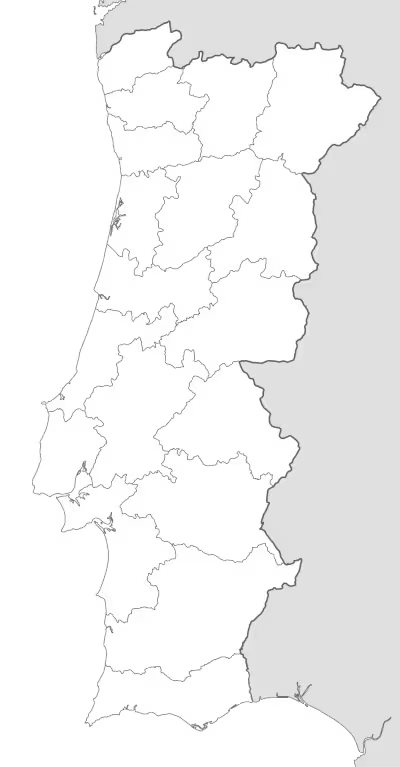
Here you’ll find a map with the political divisions of Portugal, available for free download and printing.
This PDF-format map is an educational tool designed for students, teachers, and anyone interested in learning more about the country’s geography.
The map shows international borders as well as the boundaries of Portugal. The map does not label regions or large cities, and doesn’t include rivers.
Portugal is located in southwestern Europe, on the western edge of the Iberian Peninsula. It borders Spain to the north and east and is bordered by the Atlantic Ocean to the west and south, which has strongly influenced its history and maritime character. The country covers an area of approximately 92,200 square kilometers, making it a medium-sized European nation.
Portugal’s main rivers flow from east to west toward the Atlantic Ocean. The most important are the Tagus (Tejo), the longest river in the country, the Douro, the Guadiana, and the Mondego. These rivers play a key role in agriculture, hydroelectric power, and urban development, and several of them are shared with Spain.
The country’s geography is diverse, with mountainous regions in the north and interior, rolling plains in the south, and an extensive Atlantic coastline. Northern Portugal is characterized by higher elevations and more rugged terrain, while the Alentejo region features broad plains. The Algarve, in the south, is known for its cliffs and sandy beaches. Portugal has a predominantly Mediterranean climate with strong Atlantic influences.
Administratively, Portugal is divided into 18 districts on the mainland, along with two autonomous regions: the Azores and Madeira. The country has a population of approximately 10.4 million people, concentrated mainly in urban areas such as Lisbon and Porto, while large rural areas experience lower population density.

Map of Portugal
Find more content on Mentes Liberadas
That’s all for this article. I hope you enjoyed it.
You can make a donation to Mentes Liberadas through our Ko-Fi account. This way, you’ll be supporting the site, helping us create more content, resources, and online tools.
Thank you for taking the time to read.
See you in the next article on Mentes Liberadas.