
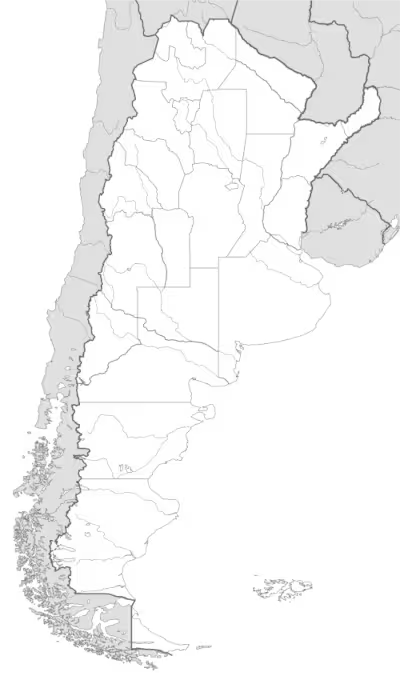
Here you’ll find a map with the political divisions of Argentina, available for free download and printing.
This PDF-format map is an educational tool designed for students, teachers, and anyone interested in learning more about the country’s geography.
The map shows international borders as well as the boundaries of Argentina. The map does not label regions or large cities.
Argentina is located in southern South America, occupying a large portion of the continent’s southern cone. It borders Chile to the west, Bolivia and Paraguay to the north, Brazil and Uruguay to the northeast, and has an extensive coastline along the South Atlantic Ocean to the east. With a surface area of approximately 2.78 million square kilometers, Argentina is the second-largest country in South America and one of the largest in the world.
The country has an extensive river system, dominated by the La Plata Basin, one of the most important in the continent. Major rivers include the Paraná, the Uruguay, and the Paraguay, which together form the Río de la Plata estuary. Other significant rivers are the Colorado, the Negro, and the Salado. These waterways are essential for agriculture, transportation, hydroelectric power, and regional development.
Argentina’s geography is highly diverse, stretching from the Andes Mountains in the west—where Aconcagua, the highest peak outside Asia, is located—to vast plains known as the Pampas, which are among the most fertile agricultural regions in the world. The country also includes Patagonia, characterized by plateaus, glaciers, and a cold, arid climate, as well as subtropical forests in the northeast. This geographic diversity results in a wide range of climates, from subtropical to subpolar.
Administratively, Argentina is divided into 23 provinces and the Autonomous City of Buenos Aires, which serves as the national capital. Argentina also includes the Malvinas Islands and the South Atlantic Islands as part of its territorial claims. The country has a population of approximately 46 million people, concentrated mainly in urban areas, particularly in the Buenos Aires metropolitan region, while large portions of the interior remain sparsely populated.

Map of Argentina
Find more content on Mentes Liberadas
That’s all for this article. I hope you enjoyed it.
You can make a donation to Mentes Liberadas through our Ko-Fi account. This way, you’ll be supporting the site, helping us create more content, resources, and online tools.
Thank you for taking the time to read.
See you in the next article on Mentes Liberadas.