
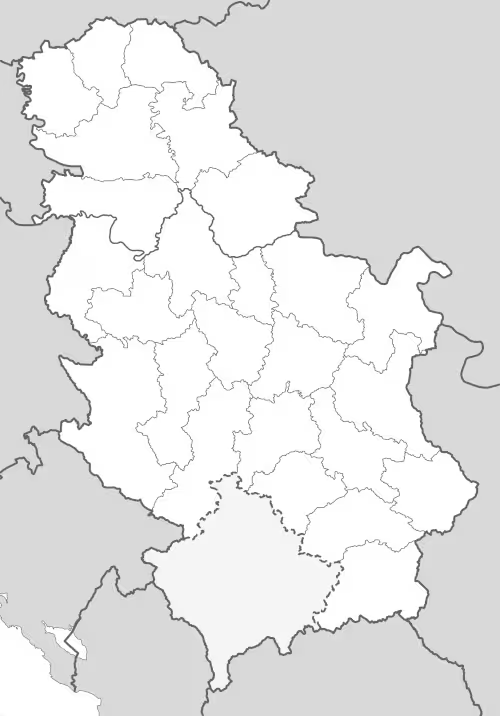
Here you’ll find a map with the political divisions of the Serbia, available for free download and printing.
This PDF-format map is an educational tool designed for students, teachers, and anyone interested in learning more about the country’s geography.
The map shows international borders as well as the boundaries of Serbia. The map does not label regions or large cities, and doesn’t include rivers.
Serbia is located in Southeastern Europe, in the Balkan region, and is a landlocked country. It borders Hungary to the north, Romania to the northeast, Bulgaria to the east, North Macedonia to the south, and Montenegro, Bosnia and Herzegovina, and Croatia to the west. The country covers an area of approximately 88,400 square kilometers, placing it among the medium-sized states of the Balkans.
The country is crossed by several major rivers, with the Danube being the most important, as it flows through the territory from west to east and connects Serbia with Central and Eastern Europe. Other significant rivers include the Sava, the Tisza, and the Morava, which are essential for agriculture, transportation, and economic development. Serbia’s geography is diverse, featuring fertile plains in the north—particularly in the Vojvodina region—and hilly and mountainous areas in the central and southern parts, intersected by river valleys.
Administratively, Serbia is divided into 29 administrative districts, in addition to the city of Belgrade, which holds a special status as the capital. The country also includes two autonomous provinces: Vojvodina and Kosovo and Metohija, the latter having a disputed status. Serbia’s population is approximately 6.6 million people, with the majority living in urban centers such as Belgrade, Novi Sad, and Niš, amid a gradual demographic decline in recent decades.

Map of Serbia
Find more content on Mentes Liberadas
That’s all for this article. I hope you enjoyed it.
You can make a donation to Mentes Liberadas through our Ko-Fi account. This way, you’ll be supporting the site, helping us create more content, resources, and online tools.
Thank you for taking the time to read.
See you in the next article on Mentes Liberadas.